
For fourteen years, I’ve been building integrations across healthcare.
Different systems. Different vendors. Different use cases. Same issues.
A workflow that someone needs can’t be supported.
An integration takes weeks or months to build.
I always thought no-code would fix this.
Drag and drop.
Connect systems.
Build workflows without engineers.
But the reality is, interface engines are still built for engineers.
They’re complex, full of jargon, and hard to work with.
The “no-code” layer doesn’t really change that.
Because in healthcare, things always change.
Workflows get more complex.
Edge cases show up.
Data isn’t clean.
Standards aren’t implemented the same way twice.
The Problem Was Never Code
No-code tools assume workflows are structured.
Healthcare workflows aren’t.
A single integration might involve:
- An HL7 feed from one system
- A FHIR API from another
- A PDF that was faxed in
- A portal with no API
- A person making a decision in the middle
That’s what real workflows look like.
And it doesn’t map cleanly to boxes and arrows.
So teams compensate.
They add scripts.
They build workarounds.
They handle exceptions manually.
The complexity never goes away.
What’s Actually Changing
There’s a shift happening now - agentic workflows.
The name isn’t important.
What matters is this:
We’re moving from manually defining every step
to systems that can help you build workflows by typing plain English.
Instead of wiring everything yourself, you have systems that can:
Read documentation
Understand message structures
Generate mappings
Decide how to move data between systems
Adjust when something changes
Teams are building workflows faster.
Reducing time to delivery.
Spending less time debugging.
Where Most People Get It Wrong
The reaction to this shift has been predictable.
Take the existing system and bolt AI on top of it.
Add a chatbot.
Add an “AI assistant.”
Maybe let it generate a step or two.
That’s not transformation.
That’s layering AI on top of a system that wasn’t designed for it.
And it doesn’t work well.
Because the bottleneck was never “we didn’t have AI.”
The bottleneck is how workflows are designed, built, and maintained.
If you don’t change that, nothing really changes.
You just get a slightly faster version of the same problem.
What Actually Works
The teams seeing real results aren’t bolting agents onto old systems.
They’re redesigning the entire approach.
That means accepting a few things:
Workflows aren’t clean.
Standards aren’t consistent.
Systems don’t behave the way they should.
And building around that reality.
The model that’s emerging looks like this:
AI handles the messy parts, but execution is still deterministic:
Because in healthcare, you don’t get to guess.
You need to know exactly what happened.
What We’re Doing at Fethr
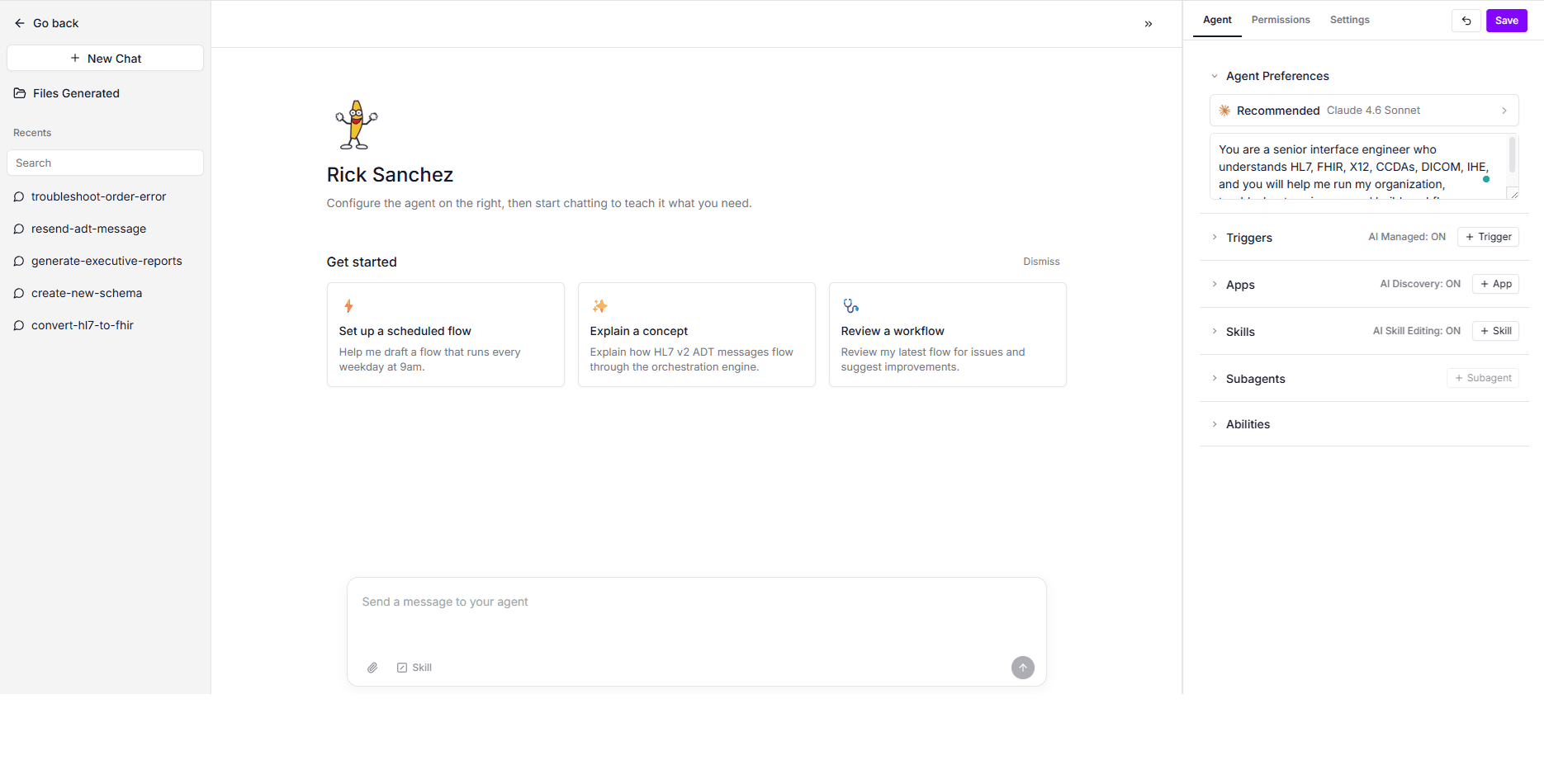
This is exactly why we’re building Fethr the way we are.
We’re not taking a legacy integration engine and adding an AI layer on top.
We’re not building a chatbot and calling it automation.
We’re rethinking the entire system from the ground up.
Every design decision.
How workflows are created.
How they’re maintained.
How data is handled.
How exceptions are managed.
All of it.
The goal isn’t to make existing workflows slightly easier to build.
It’s to reduce how much of the workflow needs to be built manually in the first place.
Where This Is Going
You won’t start from scratch every time.
You’ll start with an outcome:
“When a referral comes in, match the patient, verify insurance, pull records, and route it.”
The system generates the workflow.
You review it.
Adjust it.
Approve it.
Over time, the process gets faster and more reliable.